00:16
The staid higher-education business is about to experience a welcome earthquake

FROM Oxford's quads to Harvard Yard and numerous a steel and glass castle of advanced education in the middle of, exams are offering approach to occasions. As understudies consider life after graduation, colleges are confronting inquiries regarding their own particular future. The advanced education model of addressing, packing and examination has scarcely changed for a considerable length of time. Presently, three problematic waves are debilitating to overturn built up methods for showing and learning.
On one front, a financing emergency has made a deficiency that the colleges' brightest brains are attempting to illuminate. Organizations' expenses are rising, inferable from pricey interests in innovation, instructors' pay rates and jogging managerial expenses. That comes as governments presume that they can no more bear to finance colleges as liberally as they used to. American schools, specifically, are under weight: a few examiners anticipate mass liquidations inside of two decades.
In the meantime, an innovative unrest is testing advanced education's plan of action. A blast in internet adapting, quite a bit of it free, implies that the learning once bestowed to a fortunate few has been discharged to anybody with a cell phone or portable PC. These budgetary and mechanical interruptions concur with a third awesome change: though colleges used to instruct just a little first class, they are presently in charge of preparing and retraining specialists all through their vocations. By what means will they survive this tempest—and what will rise in their place in the event that they don't?
Money 101
Colleges have passed the greater part of their increasing expenses on to understudies. Expenses in private non-benefit colleges in America ascended by 28% in genuine terms in the decade to 2012, and have kept on edging up. State funded colleges expanded their expenses by 27% in the five years to 2012. Their normal charges are presently just about $8,400 for understudies concentrating on in-state, and more than $19,000 for the rest. At private universities normal educational cost is more than $30,000 (66% of understudies advantage from bursaries of some sort). American understudy obligation means $1.2 trillion, with more than 7m individuals in default.
For quite a while the obligation appeared to be justified, despite all the trouble. For most understudies the "graduate premium" of better-paid employments still reimburses the expense of getting a degree (see article). Yet, not all courses pay for themselves, and compliment graduate compensations mean it takes understudies longer to begin winning great cash. Understudy enrolments in America, which ascended from 15.2m in 1999 to 20.4m in 2011, have impeded, falling by 2% in 2012.
Little private universities are presently attempting to adjust their books. Susan Fitzgerald of Moody's, a FICO score office, anticipates a "demise winding" of terminations. William Bowen, a previous president of Princeton University, discusses an "expense infection", in which colleges are putting luxuriously in sparkling graduate focuses, libraries and settlement to draw in understudies.
Politically, the state of mind has moved as well. Both Bill Clinton and Barack Obama have said that colleges confront a poor standpoint on the off chance that they can't bring down their expenses, denoting a movement from the propensity of focus left government officials to support more open spending on the scholarly world. Cuts made by state governments have been halfway balanced by an increment in elected "Pell Grants" to poor understudies. Be that as it may, American colleges will soon get more cash from educational cost expenses than from open subsidizing (see outline 1).
In Asia educational cost expense expansion, running at around 5% for as long as five years among driving colleges, has stirred white collar class tensions about the expense of school. Latin American nations fuss about keeping charges sufficiently low to grow the pool of graduates. In Europe large amounts of sponsorship, combined with lower rates of school participation, have protected colleges. Be that as it may, expenses are going up: in 1998 Britain presented yearly educational cost charges of just £1,000 (then $1,650), which by 2012 had expanded to a most extreme of £9,000 ($13,900).
Increasing expenses could barely strike at a more regrettable time. Around the globe interest for retraining and proceeding with instruction is taking off among laborers of all ages. Globalization and computerization have contracted the quantity of occupations requiring a mediocre level of instruction. Those specialists with the way to do as such have looked for more instruction, trying to stay in front of the work interest bend. In America, advanced education enrolment by understudies matured 35 or more established rose by 314,000 in the 1990s, however by 899,000 in the 2000s.
Changes in machine knowledge are empowering computerization to crawl into new parts of the economy, from accounting to retail. New online plans of action undermine divisions that had, up to this point, weathered the web storm. Carl Benedikt Frey and Michael Osborne, of Oxford University, figure that maybe 47% of occupations could be robotized in the following couple of decades. They find that the chances of relocation drop pointedly as instructive fulfillment rises.
iPad illuminatio mea
So interest for instruction will develop. Who will meet it? Colleges confront another rival as gigantic open online courses, or MOOCs. These digitally-conveyed courses, which show understudies by means of the web or tablet applications, have enormous points of interest over their set up opponents. With low startup costs and intense economies of scale, online courses significantly bring down the cost of removing so as to learn and enlarge access to it, the requirement for understudies to be taught at set times or puts. The ease of giving courses—making another one expenses about $70,000—implies they can be sold efficiently, or even given away. Clayton Christensen of Harvard Business School considers MOOCs an intense "troublesome innovation" that will slaughter off numerous wasteful colleges. "A long time from now more than half of the colleges [in America] will be in liquidation," he anticipated a year ago.
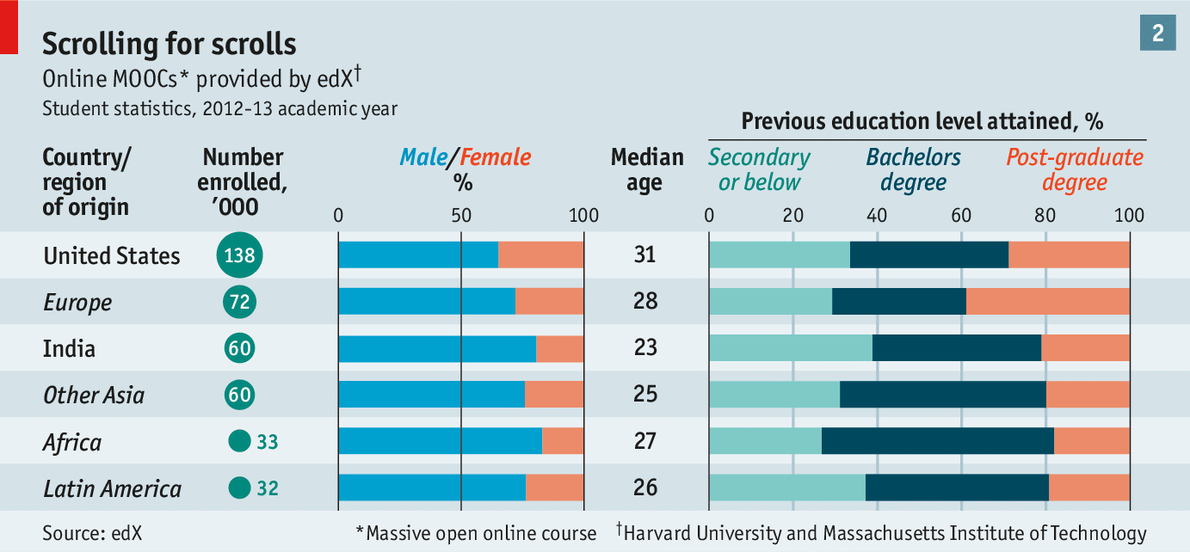
The main MOOC started life in Canada in 2008 as an internet figuring course. It was 2012, named the "year of the MOOC", that produced vatic fervor about the thought. Three major MOOC-sters were dispatched: edX, a non-benefit supplier keep running by Harvard and the Massachusetts Institute of Technology (MIT); Coursera, banded together with Stanford University; and Udacity, a revenue driven helped to establish by Sebastian Thrun, who taught a web figuring course at Stanford. The huge three have so far given courses to more than 12m understudies. Just shy of 33% are Americans, yet edX says about a large portion of its understudies originate from creating nations (see diagram 2). Coursera's new CEO, Richard Levin, a previous president of Yale University, arranges an extension concentrating




0 comments:
Post a Comment