This is default featured slide 1 title

Go to Blogger edit html and find these sentences.Now replace these sentences with your own descriptions.

This is default featured slide 2 title

Go to Blogger edit html and find these sentences.Now replace these sentences with your own descriptions.

This is default featured slide 3 title

Go to Blogger edit html and find these sentences.Now replace these sentences with your own descriptions.

This is default featured slide 4 title

Go to Blogger edit html and find these sentences.Now replace these sentences with your own descriptions.

This is default featured slide 5 title

Go to Blogger edit html and find these sentences.Now replace these sentences with your own descriptions.

Saturday, 28 November 2015

Consider an Online MBA Program With a Residency Component

Business executive team, portrait

For busy working professionals considering an MBA, online programs can certainly have their appeal.Online MBA students get to avoid the daily commute to campus and keep their day jobs without relocating across the country.
But students who think they can complete their degree without ever filling up the gas tank or banking some air miles may be mistaken.
Some online MBA options – and many of the top programs – have residency components that require students to meet up at certain locations throughout the year. Students may spend days or weeks participating in seminars, socializing and learning from business leaders.
[Explore networking tips for online MBA students.]
"For online MBA programs at any business school of national status, a required residency component (big or small) is predominant," says Phil Powell, faculty chairman of Kelly Direct, Indiana University'sonline business school programs, through email. "I think it has evolved as a common standard."

While residencies can have a host of benefits, including making an online MBA program feel intimate, experts say they're not always a viable option for prospective students in terms of time and money. Before students choose to pursue a program with a residency program, in other words, they should have a sense of what they're getting into.
Among the potential benefits of online MBA residencies is the chance to build a professional network. 
While establishing personal and professional connections is one of the most important parts of MBA programs, creating that network in an online program isn't always easy. "One of the challenges of an online MBA is that you really don't get that personal touch – it can be a bit distant," says Hansel Rodriguez, a student at the University of North Carolina—Chapel Hill's online MBA program, called MBA@UNC.
Rodriguez got a chance to strengthen his network by taking part in three residencies, or what his program calls immersions, in New York, San Francisco and Mumbai, India. 
UNC's program requires students to participate in a three-day immersion experience from Friday through Sunday at least twice during their studies. The weekends, which are offered both domestically and abroad, combine classes, socializing and meetings with business and thought leaders. 
"It gives you the opportunity to see your classmates in a social setting, and you get to build those social relationships," says Rodriguez, director of operations for the National Security Council at the White House. "I just went to a classmate of mine's wedding – it shows you the kind of relationships you get to build." 
Another perk of residencies, experts say, is their ability to enhance the MBA educational experience​​​​​​​​​​​​​​. While students can soak up a lot of knowledge in an online classroom, residency requirements can give them ​face-to-face access to businesses, industry leaders and faculty who they may not encounter elsewhere.  
[Seek online MBA programs that provide travel opportunities.]
Leah Miller, a student​ in the online MBA program at Pennsylvania State University—World Campus​, says the chance to have practical experience outside the classroom was one of the main reasons she chose​ a program with a residency. In May of 2014, ​she and her classmates had a weeklong​ stay in Virginia, where they shadowed and studied the Mitre ​Corporation, a nonprofit company that operates federally funded research and development centers. At the end of the residency, students were expected to create a presentation analyzing the company.
"There was someone of the executive level at everything we did," says Miller. "Having that time to interact with them, that was really eye-opening for us."

Unfortunately, even prospective students who want a residency requirement might not be able to swing it. 
"Possible drawbacks would probably be logistics and financing," says Ashley Kilburn, MBA coordinator for the University of Tennessee—Martin. Students typically have to front ​travel costs and use vacation days for these opportunities, she says. 
Some companies may allow students to attend a residency without using vacation days, but that is rare, Kilburn says. 
Miller, manager of operations innovation at The Hershey Company​, was able to get her company to let her attend residency without taking vacation days by explaining how the program would help her better manage capital projects, part of her job.
The downside: On top of 12 hours a day of school commitments, there was still her own work to do. "It was a tough week," she says.
If prospective students do indeed decide to pursue a program with a residency, experts say it's best to research the program in advance to make sure it meets their needs.
[Learn why it may be easier to get into online MBA programs.]
"Residencies can be good, can be bad, and of no value," says Ashutosh Deshmukh, the head of the online MBA program at Penn State. "It depends on the program."  
One way to make sure a program's residency is worthwhile is to track down alumni of the program and ask about their experience, says Kilburn.
"I think that from a student's perspective that would be very credible and very helpful," she says. "What are students actually saying about it and their experience?"
Trying to fund your online education? Get tips and more in the U.S. News Paying for Online Education center.

15 steps closer to quality higher education in Africa

The University of Cape Town's Drug Discovery and Development Centre (H3-D).
Collaborate across universities: Faced with a lack of essential services such as transport, water, power, healthcare and educational systems, and a government uninterested in investing in research, the question of how African countries can conduct cutting-edge research to tackle problems related to local needs can be difficult. One solution is to form collaborations among scientists in different universities. Sadiq Yusuf, deputy vice chancellor academic affairs, Kampala International University, director of African affairs, TReND, Kampala, Uganda,@sadiqyusuf12
Harness the potential of e-learning: Massive open online courses (MOOCs) and online universities such as Singularity University andMinerva are revolutionising learning and Africa has an opportunity to think deeply about providing quality education online, and figure out how to make it less costly and more interactive. James Kassaga Arinaitwe, global fellow, Acumen, Bangalore, India, @JamesArinaitwe
Stop neglecting science, technology, engineering and maths (STEM):Providing tertiary education in technical fields can be significantly more costly than social sciences, forcing cash-strapped public education institutions to reduce expansion in this area. This has contributed to higher education systems that are skewed towards the social sciences, rather than teaching applied science, engineering and technology skills, which the continent urgently needs. Álvaro Sobrinho, chair, Planet Earth Institute, London, UK, @Alvaro_Sobrinho
But don’t forget the social sciences: Social sciences have an important role to play here too. There are many stories of technological development not serving African communities because their needs weren’t understood. If we can envisage greater collaboration across the disciplines, technology and science can deliver on their promise and potential. Can teams of researchers include social scientists alongside natural scientists and engineers? The Ebola outbreak is just the most recent and headline-catching event to have shown what happens when the social dimensions are ignored. Jonathan Harle, senior programme manager, Inasp, Oxford, UK
Invest in quality: More and more students are gaining access but how useful is it to scale up inefficiencies? A quality programme would have a curriculum that is reviewed and refreshed with emerging content. Ideally learning goals would be re-examined and strengthened in tandem with the human capital needs of the economy. Beatrice Muganda, director of higher education, Partnership for African Social and Governance Research, Nairobi, Kenya, @PASGR_
Redefine ‘quality’ research: African researchers are challenged to perform on an international stage, but also show how their work contributes to local needs. When the former pushes for publication in the high impact journals this can often be at odds with ways of communicating research which better serve the latter. What is understood as quality is often defined in the north, and that imbalances things. The way quality is measured (through the journal rankings and related metrics) is a narrow measure, but is extremely influential in global debates on higher education. Jonathan Harle
Make academia relevant: It is critical for African researchers to focus on the pressing challenges facing the continent, from climate change to human rights to transformations in science and technology. The key is to develop vibrant African outlets of knowledge production, and strengthen collaborations for African researchers within the continent and with the African academic diaspora, as well as with other international colleagues. Paul Tiyambe Zeleza, vice president of academic affairs and professor of history,Quinnipiac University, Connecticut, US
Link study to jobs: Ensuring the relevance of training is critical to ensure that capacities are developed that will enable university graduates to find highly skilled jobs in their home countries and go on to play a crucial role as agents of change over the continent. This is where the links between universities, the local and international private sector and policymakers become crucial for facilitating the transfer of knowledge from and to private businesses and political decision makers. Charlotte Siegerstetter, implementing manager, GIZ, Tlemcen, Algeria, @c_siegerstetter
Acknowledge the problems: Corruption and nepotism have contributed to the failure of higher education in Africa. In Nigeria, some universities are going through a financial crunch and unable to pay staff salaries because they spent so much money on the election. There is a need to transform our senior management. These problems can’t continue, a concerted movement for change is called for. Sola Adesola, senior lecturer, Oxford Brookes University, Oxford UK,@AGPUK
Start innovation hubs: We need huge amounts of money supporting innovation. Having incubation centres at each university where even social science students are engaged in experiments pertinent to what their “world of work” would look like will further creativity and solve some of our education quality challenges such as churning out unskilled youth. However, this takes leadership on the government and private education part. James Kassaga Arinaitwe
Don’t just copy out-of-date western models: Our education leaders and policymakers should be careful about copy-and-paste models from the west. Harvard, MIT, Oxford and many universities are struggling to remain relevant to the growing number of online courses and universities. In fact they are surviving in part because of the influx of international students from Asia, Africa and other parts of the world. So shouldAfrica continue copying what top universities in the west are doing, or should we think of another approach? James Kassaga Arinaitwe
Follow Ethiopia’s footsteps: The government of Ethiopia is a great example of a government prioritising higher education and making it more relevant to local needs. For example, it has rapidly expanded its higher education system in recent years, and introduced a policy designed to shift the balance of subjects in all public universities away from the humanities and towards the sciences and technology, on a 70:30 basis. The University of Jimma is a great success story. Since the department of materials science and engineering opened in 2013, it has rapidly expanded to become one of the top research schools in the sub-Saharan region. Álvaro Sobrinho
Work with the private sector: As the leading source of job creation, the private sector can help institutions equip the continent’s youth with skills for the workplace. For example, businesses can partner with local universities to create high quality STEM curricula. Businesses could help overworked faculties to design and deliver courses that equip students with both a deep understanding of science and technology, as well as practical skills for the workplace. Álvaro Sobrinho
Encourage students to direct their own learning: African universities have access to a huge volume of the latest journals and books which could do a lot to improve the quality of education, but they often don’t get used much. If reading lists were refreshed, and academics encouraged their students to use them, it would make a difference.Jonathan Harle
Convince governments that universities are the route to development:We need to persuade African governments that investing in higher education can help their countries reach middle-income status faster, an aspiration for many. For example, South Korea transformed itselffrom an aid-recipient country to a donor country through rapid economic growth and prosperity in just 50 years. Álvaro Sobrinho

From the archive, 11 September 1964: 'Open university' of air and mail

A student watching an Open University broadcast, 9 February 1971.

The first scheme for an “open university” is announced today by Dr Michael Young, chairman of the Advisory Centre of Education. ACE’s National Extension College is asking the Department of Education for £2 millions a year for this purpose.
Mr Young’s scheme is given in the form of a report of a conference on television and correspondence, which was opened by Sir Edward Boyle, Minister of State for Education and Science, and chaired by Mr A. D. C. Peterson, of the Oxford University Department of Education.
A full account appears in the current issue of ACE’s journal, “Where?” Dr Young says that the popular title “University of the Air” is too limiting. The “open university” proposed would combine television and radio tuition with correspondence courses and face-to-face teaching on special residential courses.
The scheme builds on the beginning made in this way in Cambridge by ACE’s National Extension College. It would be one response to the growing gap between supply and demand for education.
Slipped through
The students in this open university would be people who had slipped through the rungs of the conventional education system. They might be people wanting qualifications in middle life; would-be university students shut out because of the “bulge”; apprentices and technicians needing some grasp of science and engineering; married women housebound with small children; students from emerging countries working for examinations of British universities.
At first the new college would have to prepare its students for the examinations of other bodies but, because the needs of its students would differ from those of internal university students, the college would need eventually to award its own degrees, diplomas, and qualifications.
Dr Young says that courses designed to meet the needs of home students would have to break radically from those traditional to Britain. They could well be modelled much more along the lines of the American credit system, with only the final examination being a comprehensive test of all the subjects covered.
The new college would cooperate with the more efficient correspondence colleges and where a new approach was needed the college would prepare its own courses. The college would not attempt to give complete courses on radio or television alone. Even if an entire television channel were devoted exclusively to education, it would not provide enough hours, and the cost would be prohibitive.
The new college would encourage its students to form “local circles” to hear speakers and to hold seminars. In areas without enough students for this, residential courses would be essential, and the college would do its best to persuade employers to give its students extra leave for these.
The report calculates that to have 20,000 degree students after five years would cost the college annually £1,200,000, of which the students could contribute £250,000. A similar amount would be needed for nondegree students, so that the new college would probably require £2 millions a year, “much less than even the smallest orthodox university.” The National Extension College will apply to the Department of Education and Science, ager the general election, for this sum.

‘This change will be the end of the Open University as we know it’

Tony Coughlan, who has been with the OU for 13 years, outside the Bristol regional centre

When the Open University announced last month that it would be closing seven of its nine regional centres in England, it said it was a response to the changing demands of students, rather than funding.
“The way in which we support our students has changed significantly,” says Keith Zimmerman, the university secretary. “It is now almost entirely online. Very few of our students come into our offices.” He says that by selling off university buildings and concentrating on just three offices in England and another four in the rest of Britain and Ireland, the OU will be able to release money to spend on responding to student queries more quickly and outside traditional working hours.
But staff say abandoning many of the opportunities for face-to-face contact and support will change the OU’s ethos. The University and College Union (UCU) is balloting for strike action over the closures after a university senate meeting last week voted in favour of rejecting the plans as “high risk” and “failing adequately to support the academic mission of the university”. The university has nevertheless decided to continue with its proposals, due to come into force by February 2017, and its council will make a final decision in November.
Philip O’Sullivan, lecturer in the faculty of social sciences at the OU and a UCU representative, says: “This is the most fundamental change in the way the university operates in England since the creation of the OU over 45 years ago, and tutors and academic colleagues have said to me this will be the end of the OU in England as we know it.” He says student support staff and academics work at the university because the OU transforms people’s lives. “They give everything to it and are seeing all the values and ethos of the institution being torn apart.” He believes financial cuts are at least part of the reason for the closures.
The university stands to save £5m out of a total budget of more than £400m by closing the centres. It has been hard hit by the dramatic decline in numbers of part-time students after changes to higher education funding, including the introduction of £9,000 tuition fees. The institution, which has almost 200,000 students, has the largest concentration of part-time students of any UK university, and student numbers fell by about 10% between 2011-12 and 2013-14. At the same time, an £18.8m surplus turned into a £16.9m deficit.
But, as a leader in distance learning, the university is also vulnerable to the seismic changes brought about by technology. “The OU is struggling to find its place in a world that has moved on,” says Mike Boxall, higher education expert at PA Consulting Group. “Most universities now have substantial online offerings, especially in business and areas like that. [The OU] haven’t got the field to themselves in the way they had.”
Three years ago, Clay Shirky, associate professor at New York University and commentator on internet technologies, predicted a revolution in higher education brought about by massive open online courses (Moocs), which are free to anyone in the world with access to a computer. He compared their likely effect to that of Spotify on the music industry, predicting they would cause some traditional institutions to fail while opportunities would emerge for people ill-served or shut out of the current system. The former universities minister David Willetts also saw them as a way to widen access to UK university education, particularly for students from abroad.
Most universities have embraced Moocs enthusiastically, including the OU. It said last year’s deficit was in part the result of the need to invest in “strategic projects”, and one of the most expensive of these – costing about £10m – wasFutureLearn, a Mooc platform it owns as a commercial subsidiary and develops in partnership with 72 academic institutions and specialist organisations.
This month – its second anniversary – FutureLearn celebrated its five millionth enrolment, with about 2.5 million people signed up (many sign up for more than one course).
“We are just scratching the surface of what we can do,” says Simon Nelson, FutureLearn’s CEO, who is particularly proud of its achievements in social learning: about 40% of people taking a FutureLearn course engage in its social environment, such as writing on forums and contributing content. “We are trying to create a community of learners who don’t only engage with content but engage with each other, as well as with teachers and those who facilitate their learning.”
But other online experts say that although they are excited about the possibilities offered by Moocs, they recognise their limitations, particularly when it comes to engagement.
“The great difficulty with Moocs is that by far the largest proportion of people who take them are highly qualified professionals,” says Diana Laurillard, professor of learning with digital technologies at the Institute of Education. “The kind of learning they deliver isn’t well designed for people who want to try out university. At that stage of your learning you need a lot of scaffolding and hand-holding and feedback on what you are doing.”
Sarah Speight, professor of higher education and academic director of online learning at the University of Nottingham, says elite universities originally viewed Moocs as a way of widening participation, but there has been little evidence of them achieving that. She argues institutions have moved beyond the stage of altruism and are seeking to use Moocs for continuing professional development and bite-size professional learning. “Widening access was always a bit pie in the sky.”
Nelson says 70% of those taking courses with FutureLearn already have a degree, or higher, but says students also include sixth formers and retired people studying arts subjects. However, many businesses and non-governmental organisations are recognising the opportunities Moocs offer for staff training.
OU students are now more likely to be studying for career reasons, and to be in work – but they are also more likely to come without previous higher education experience. This is one reason, Zimmerman says, for the decision to close the regional centres. He argues that these students want more online access to support, especially as they are getting younger – the average age of OU students has dropped from 38 to 28 in less than 15 years.
But those who oppose the closures argue that these students need even more support on the ground than their predecessors. Tony Coughlan, a tutor at the OU’s Bristol office, says that while you can now find a textbook online on virtually any subject, and Moocs offer endless opportunities for learning, “what you don’t get is a person who can personalise the learning experience.
“That’s what the regions have done. People new to social learning get carried away and forget that,” he says.

Our students won’t feel connected’


Over my time here our teaching has got better because we are able to use e-resources, ebooks, e-journals, and in our face-to-face and community sessions we can concentrate on things that really benefit from discussion and exploration with the students, writes OU lecturer Tony Coughlan.
We no longer have to photocopy extracts from books and journals and distribute them. The photocopier used to be really busy in the runup to a tutorial. In the past we would still have had online forums but they were more administrative, more about handing-in dates for essays and arrangements for face-to-face meetings, and lift-sharing.
A lot of students now are in different Facebook groups. We see people working out their ideas, discussing topical things and how to incorporate them in assignments, although there are still lift-sharing stuff and pictures of kittens and photos of the work stations they’ve set up in their bedrooms.
But it really only works when they have met face to face. It’s very hard to create a sense of community from scratch online. All the evidence shows you meet face to face, then you can continue your relationship online.
I remember when you turned up to one of our study centres on a Saturday and there were hundreds of students all clutching their bags. There was an excitement and sense of being part of a learning community. It was thrilling and really motivating. You don’t get that so much online. There is a sense when you are part of a community that you aren’t alone. If you are feeling a bit wobbly and thinking of throwing in the towel, you see lots of other people in the same position and it helps you carry on.
That’s the bit the university seems to want to do away with now. Those of us familiar with the role we play are worried that without that, students won’t feel connected to the university and to one another, which is really important.

OU: what we know

•Founded in 1969 by social activist Michael Young (later Lord Young)
• Mission: “We promote educational opportunity and social justice”
• Based in Milton Keynes, Buckinghamshire
• 2010-11: number of students: 207,250
• 2013-14: number of students: 168,000
• 2010-11: number of staff: 4,807
• 2013-14 number of staff: 4,709

Younger Students Drawn to Online Higher Education

Young woman at computer working from home

Josh Perez struggled to understand the letter he received accepting him into the University of Florida's online Pathway to Campus Enrollment initiative, or PaCE.
For one thing, he had applied to be a residential undergraduate at Florida, and he had never heard of the online program. For another, the letter read like a rejection.
Eventually, though, he realized Florida hadn't admitted him to the residential freshman class. But the school liked his application enough to offer him a spot in a new alternative program, which promised a pathway to becoming a residential student as a junior after earning 60 online credits.
"My initial reaction was, 'Oh, this is like a half admission,'" Perez recalled.
Perez consulted with family and friends, and eventually took the offer, joining a growing number of online college students who are younger than 25. A survey this year from Aslanian Market Research and The Learning House found that a third of online undergraduates are 18 to 24 years old, up from a quarter of those surveyed in 2012.
[Learn how to succeed in an online course.]
But Perez's lukewarm initial reaction to PaCE echoes another assertion that experts make about young online students – that, like most older students, they are choosing the online medium as a necessary alternative rather than a preferred one.
That's not to say younger students are in need of more alternatives now. But they've often been steered away from online programs, experts say, partly because they are perceived not to have the same self-discipline or time-management skills.
However, recent trends in K-12 education are giving younger college students more familiarity with learning online, experts say. In Florida, for example, students are required to take at least one online course to graduate high school. And at community colleges, one of the largest providers of online learning at the undergraduate level​, many dual-enrollment high school-college courses are offered in an online or hybrid format.
[Consider whether to take an online course at community college.]
"They're a lot more comfortable than, I think, even five years, 10 years ago, just in terms of using that technology," says Andrea Reese, the chair of online studies at Daytona State College, a primarily two-year institution. "That intimidation factor is gone."
At Pennsylvania State University—World Campus, Karen Pollack, the assistant vice provost for undergraduate online and blended programs, also suspects the increase in younger undergraduates she's seen may correlate with tougher financial times.
In the 2013-14 academic year, nearly 1,800 students were age 18-24, accounting for a 60 percent increase from the year before, school officials said. In terms of the entire undergraduate student body at PSU—World Campus, 18- to 24-year-olds made up 21 percent in 2013-14, compared with 18 percent the year before.​
"Possibly living at home, not paying room and board, having the flexibility that they can work 10-15 hours a week to help fund their college education – that is their reality," she says of many younger students. "Given the circumstances, it's their best option."
[Get tips on paying for an online education.]
Others, like World Campus senior Hannah Hernandez, have lifestyles that require flexibility. An Arizona native who first discovered online courses at Pima Community College, Hernandez worked toward her bachelor's degree while interning in Geneva, Brussels and now Dakar, Senegal, where her mother is working.
Hernandez loves the international ​experience she's received, but has some concerns about what she lost by forgoing campus life. She even considered completing her final semester in State College, Pennsylvania, but worried she wouldn't have enough common ground with her classmates.
"Sometimes I feel sad that I don't have the bonding experience with friends that other students get," Hernandez said. "Because I've moved around so much and have this unstable lifestyle, I have what I sort of refer to as three-month friends."
In that context, what makes the University of Florida's PaCE initiative unusual is its promise to online students of a fully on-campus experience down the road. With that promise, some students have gotten a head start on making a home near campus.
Of the 350 students who enrolled in the program for its inaugural fall semester, roughly 100 moved near campus in Gainesville, says Andy McCollough​, the associate provost for teaching and technology at the University of Florida.
Perez is in that group. He found fellow students to room with off campus through the Internet, plans to use the proximity to visit with teaching assistants and professors when needed, and has already attended a couple of in-person lectures for his microeconomics course.
McCollough hopes to double the program's freshman enrollment next fall partly by catering to those students who want to feel a part of campus life. For example, PaCE students will be able to opt into student fees that cover extracurricular activities typical for on-campus students, including the ever-popular student tickets for Florida Gators football games.
"Before we kicked off, we had thought about doing that," McCollough says. After the new online students moved to town, he says, they realized "We should've explored that more completely."
Trying to fund your online education? Get tips and more in the U.S. News Paying for Online Educationcenter.

For Online to Really Matter in Education, We Need to Redefine Competency

onlineed_660
IN THE EARLY ‘90s, I could tell what someone thought about the Internet’s prospects for transforming higher education by listening to their vocabulary. If they used terms like “distance learning” or “distance education,” they’d probably been working in continuing education for some time and saw the Internet as simply the latest in a line of technologies — beginning with correspondence courses, and including the latest two-way video systems – to expand the reach of colleges and universities. The Internet wasn’t going to disrupt the field. So why should it define it?
In contrast, those of us who rejected “distance learning” in favor of “online learning” understood that the Internet was a game changer. The potential of the new medium to not only mirror and extend the classroom but enable entirely new approaches to education was intuitive, if not obvious. And so we gathered in corners of “distance learning” conferences and symposia, whispering furtively about how the distance learning guys simply didn’t get it.
In a decade, online education may be recognized not for making higher education accessible to anyone with a smartphone—but as the midwife who delivered competency-based learning into the world. Like so many other technology-driven advances, competency-based learning is theoretically possible in a paper-pencil world. Global positioning is, after all, feasible without a handheld GPS. But it’s not nearly as appealing, and a long way from a mass-market product.
Competency-based learning turns higher education on its head – starting not with the curriculum, but rather the competencies one should exhibit upon completion (according to, say, employers). From there, course developers design assessments that test for these competencies. Then – and only then – do we turn to the task of developing the curricula that prepares students to demonstrate mastery on the assessments.
In a competency-based program, failure becomes an anachronism; students continue until they demonstrate competency. In addition, competency-based learning relegates concepts like credits, transferring credits, and perhaps financial aid to the dustbin of higher education history. Equally important, it significantly reduces the cost of delivery – by as much as half vs. seat-time-based online delivery.
If this all sounds good to you, you’re probably not an academic. Because when higher education veterans hear the term “competencies” they hear “job-related skills” or “vocational training.” Most faculty don’t see how competency-based learning relates to higher level capabilities such as critical thinking, problem solving, numerical reasoning, and locating information.

But these higher level capabilities are rooted in competencies, too. Moreover, we are increasingly able to design and deliver assessments that test for these competencies. ACT, the leading assessment organization, has profiled over 16,000 jobs by sending experts to corporate work sites and found that over 95 percent of all jobs can be expressed as a combination of three to five higher order capabilities, including applied mathematics, reading for information, and locating information.
Years before he conceived the iPod, iPhone and iPad, Steve Jobs was designing videogames for Atari. Jobs hated complicated manuals, saying products needed to be so simple that a stoned freshman could figure them out. The only instructions for the Star Trek game he built for Atari were: 1. Insert quarter. 2. Avoid Klingons.
If there’s one product or service that should be designed so that a stoned freshman can figure it out, it’s higher education. Competency based leaning holds great potential to bring a degree of transparency and simplicity to a product purportedly designed for mass consumption. I’m still not sure what language we should use. It certainly isn’t as simple as replacing “distance” with “online.” And it’s probably not “capabilities.” But the sooner higher education can get over its vocational prejudice against competencies, the sooner the online learning revolution will begin.
Ryan Craig is Managing Director at University Ventures, a fund focused on innovation from within higher education, and the author of the upcoming “College Disrupted: The Great Unbundling of Higher Education” (Palgrave Macmillan, March 2015).

Tuesday, 6 October 2015

The future of universities The digital degree

The staid higher-education business is about to experience a welcome earthquake

 FROM Oxford's quads to Harvard Yard and numerous a steel and glass castle of advanced education in the middle of, exams are offering approach to occasions. As understudies consider life after graduation, colleges are confronting inquiries regarding their own particular future. The advanced education model of addressing, packing and examination has scarcely changed for a considerable length of time. Presently, three problematic waves are debilitating to overturn built up methods for showing and learning.

On one front, a financing emergency has made a deficiency that the colleges' brightest brains are attempting to illuminate. Organizations' expenses are rising, inferable from pricey interests in innovation, instructors' pay rates and jogging managerial expenses. That comes as governments presume that they can no more bear to finance colleges as liberally as they used to. American schools, specifically, are under weight: a few examiners anticipate mass liquidations inside of two decades.

In the meantime, an innovative unrest is testing advanced education's plan of action. A blast in internet adapting, quite a bit of it free, implies that the learning once bestowed to a fortunate few has been discharged to anybody with a cell phone or portable PC. These budgetary and mechanical interruptions concur with a third awesome change: though colleges used to instruct just a little first class, they are presently in charge of preparing and retraining specialists all through their vocations. By what means will they survive this tempest—and what will rise in their place in the event that they don't?

Money 101

Colleges have passed the greater part of their increasing expenses on to understudies. Expenses in private non-benefit colleges in America ascended by 28% in genuine terms in the decade to 2012, and have kept on edging up. State funded colleges expanded their expenses by 27% in the five years to 2012. Their normal charges are presently just about $8,400 for understudies concentrating on in-state, and more than $19,000 for the rest. At private universities normal educational cost is more than $30,000 (66% of understudies advantage from bursaries of some sort). American understudy obligation means $1.2 trillion, with more than 7m individuals in default.

For quite a while the obligation appeared to be justified, despite all the trouble. For most understudies the "graduate premium" of better-paid employments still reimburses the expense of getting a degree (see article). Yet, not all courses pay for themselves, and compliment graduate compensations mean it takes understudies longer to begin winning great cash. Understudy enrolments in America, which ascended from 15.2m in 1999 to 20.4m in 2011, have impeded, falling by 2% in 2012.

Little private universities are presently attempting to adjust their books. Susan Fitzgerald of Moody's, a FICO score office, anticipates a "demise winding" of terminations. William Bowen, a previous president of Princeton University, discusses an "expense infection", in which colleges are putting luxuriously in sparkling graduate focuses, libraries and settlement to draw in understudies.

Politically, the state of mind has moved as well. Both Bill Clinton and Barack Obama have said that colleges confront a poor standpoint on the off chance that they can't bring down their expenses, denoting a movement from the propensity of focus left government officials to support more open spending on the scholarly world. Cuts made by state governments have been halfway balanced by an increment in elected "Pell Grants" to poor understudies. Be that as it may, American colleges will soon get more cash from educational cost expenses than from open subsidizing (see outline 1).

In Asia educational cost expense expansion, running at around 5% for as long as five years among driving colleges, has stirred white collar class tensions about the expense of school. Latin American nations fuss about keeping charges sufficiently low to grow the pool of graduates. In Europe large amounts of sponsorship, combined with lower rates of school participation, have protected colleges. Be that as it may, expenses are going up: in 1998 Britain presented yearly educational cost charges of just £1,000 (then $1,650), which by 2012 had expanded to a most extreme of £9,000 ($13,900).

Increasing expenses could barely strike at a more regrettable time. Around the globe interest for retraining and proceeding with instruction is taking off among laborers of all ages. Globalization and computerization have contracted the quantity of occupations requiring a mediocre level of instruction. Those specialists with the way to do as such have looked for more instruction, trying to stay in front of the work interest bend. In America, advanced education enrolment by understudies matured 35 or more established rose by 314,000 in the 1990s, however by 899,000 in the 2000s.

Changes in machine knowledge are empowering computerization to crawl into new parts of the economy, from accounting to retail. New online plans of action undermine divisions that had, up to this point, weathered the web storm. Carl Benedikt Frey and Michael Osborne, of Oxford University, figure that maybe 47% of occupations could be robotized in the following couple of decades. They find that the chances of relocation drop pointedly as instructive fulfillment rises.

iPad illuminatio mea

So interest for instruction will develop. Who will meet it? Colleges confront another rival as gigantic open online courses, or MOOCs. These digitally-conveyed courses, which show understudies by means of the web or tablet applications, have enormous points of interest over their set up opponents. With low startup costs and intense economies of scale, online courses significantly bring down the cost of removing so as to learn and enlarge access to it, the requirement for understudies to be taught at set times or puts. The ease of giving courses—making another one expenses about $70,000—implies they can be sold efficiently, or even given away. Clayton Christensen of Harvard Business School considers MOOCs an intense "troublesome innovation" that will slaughter off numerous wasteful colleges. "A long time from now more than half of the colleges [in America] will be in liquidation," he anticipated a year ago.

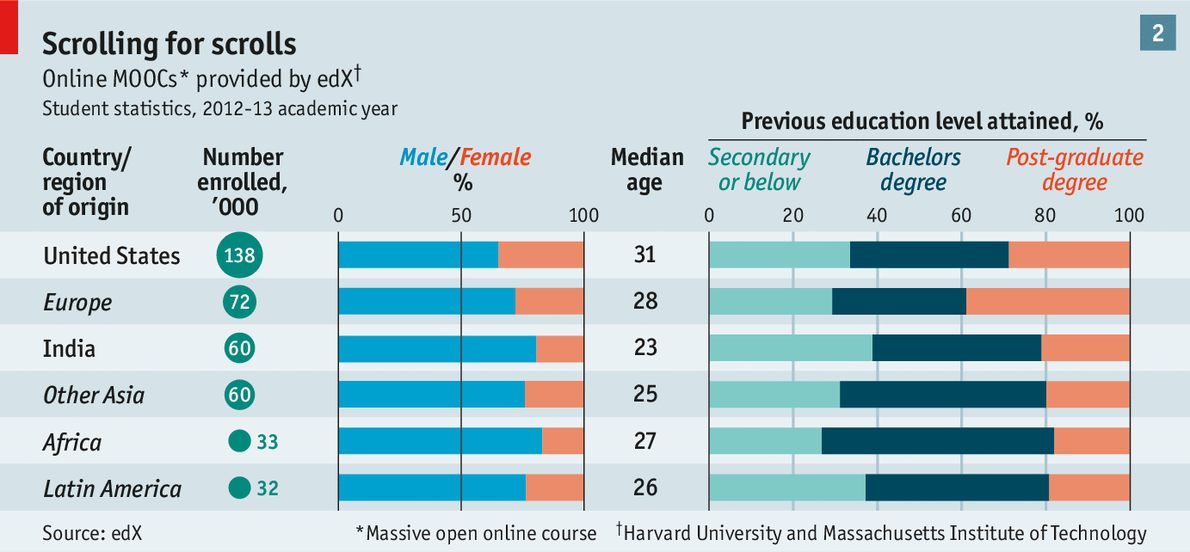
The main MOOC started life in Canada in 2008 as an internet figuring course. It was 2012, named the "year of the MOOC", that produced vatic fervor about the thought. Three major MOOC-sters were dispatched: edX, a non-benefit supplier keep running by Harvard and the Massachusetts Institute of Technology (MIT); Coursera, banded together with Stanford University; and Udacity, a revenue driven helped to establish by Sebastian Thrun, who taught a web figuring course at Stanford. The huge three have so far given courses to more than 12m understudies. Just shy of 33% are Americans, yet edX says about a large portion of its understudies originate from creating nations (see diagram 2). Coursera's new CEO, Richard Levin, a previous president of Yale University, arranges an extension concentrating